
Year Time Capsule
Remember 1940
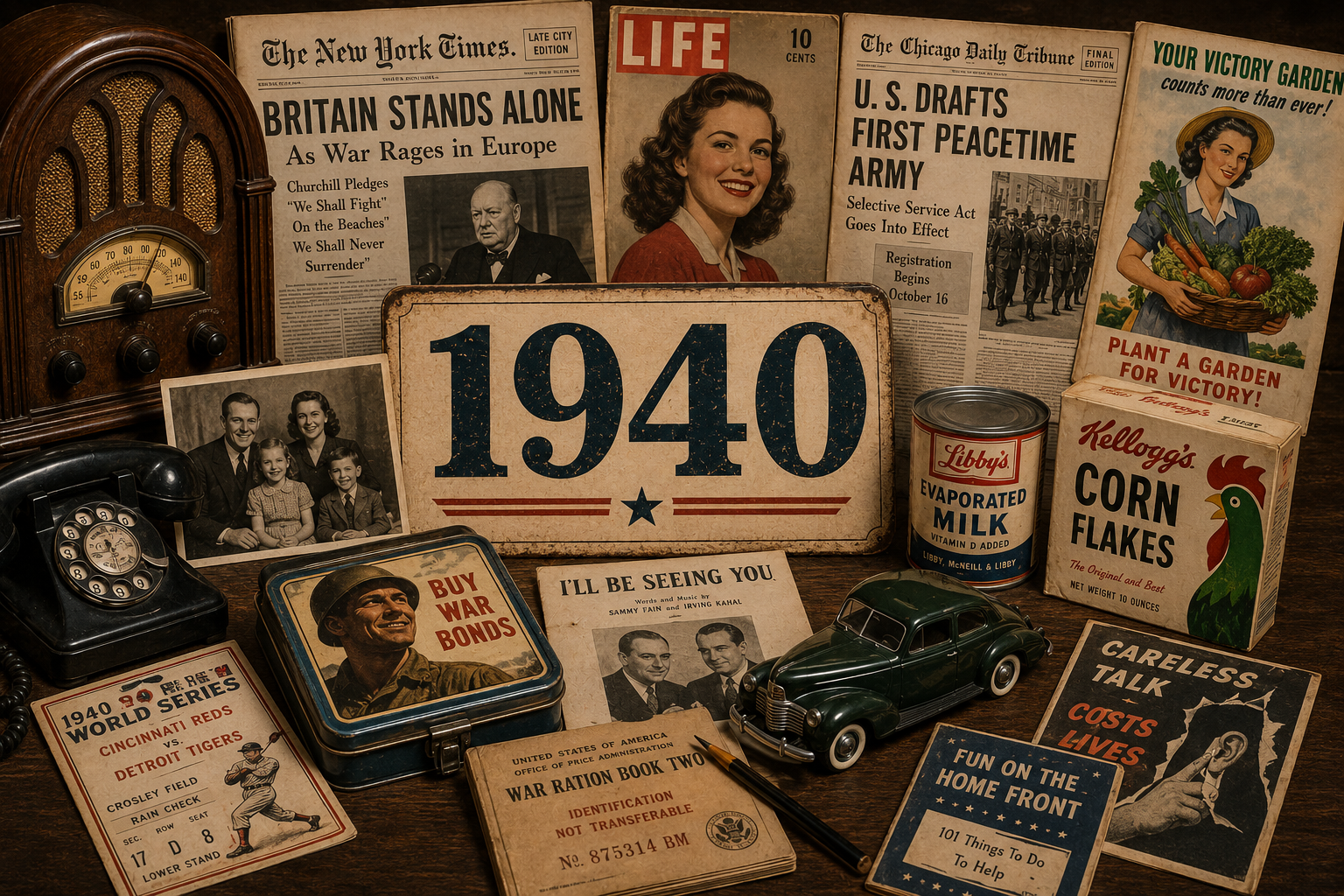
1940 opened the decade with radio nights, family photographs, newspaper headlines, big-band music, movie palaces, and the growing shadow of war. It was the year Winston Churchill became Britain’s prime minister on May 10, gave his “We shall fight on the beaches” speech on June 4, the Battle of Britain began on July 10, the Blitz began on September 7, the United States signed its first peacetime draft law on September 16, draft registration began on October 16, and Franklin D. Roosevelt won an unprecedented third term on November 5.
On This Page
Quick Look
1940 At A Glance
Before we open the full scrapbook, here are the dated milestones, pop culture moments, and everyday memories that help define 1940.
The Sound Of 1940
Music In 1940
The sound of 1940 belonged to big bands, radio singers, dance halls, sentimental ballads, movie songs, and the records people played at home. The war in Europe was already shaping the mood of the year, but American radio still carried music that could feel romantic, elegant, hopeful, or deeply wistful.
Tommy Dorsey’s “I’ll Never Smile Again,” featuring Frank Sinatra and the Pied Pipers, became one of the year’s defining popular music memories. Glenn Miller, Artie Shaw, Benny Goodman, Duke Ellington, the Andrews Sisters, Bing Crosby, and other bandleaders and singers helped fill the air with swing, dance music, and songs that traveled from records to radio to living rooms.
In 1940, a song could be something people danced to, something they heard while doing chores, something played from a jukebox, or something that made the news from Europe feel a little farther away for a few minutes.
1940 Music Memory
A 1940 song might come through a cathedral radio, a dance-band broadcast, a record player, or a movie theater speaker, but it often carried the feeling of a world trying to stay steady.
Screens And Speakers
Movies And Radio In 1940
Movies in 1940 gave audiences drama, comedy, animation, romance, social realism, and satire. Rebecca became one of the year’s prestige film memories. The Grapes Of Wrath brought Depression hardship to the screen. Pinocchio and Fantasia showed how ambitious animation could be, while The Great Dictator used comedy and seriousness to answer the world’s political moment.
His Girl Friday, The Philadelphia Story, The Shop Around The Corner, The Sea Hawk, Foreign Correspondent, and other films helped make 1940 a memorable movie year. On July 27, A Wild Hare introduced the fully formed Bugs Bunny personality that would become one of animation’s most familiar characters.
Radio was still the center of home entertainment. Families gathered around for music, comedy, drama, serials, news bulletins, sports updates, and presidential speeches. In a year when war news crossed the ocean daily, the radio was not just entertainment. It was how people felt connected to a changing world.
1940 Screen Memory
1940 movie screens offered escape, laughter, cartoons, and seriousness, while the family radio brought both songs and world news straight into the house.
Childhood Memories
Toys, Kids, And Home Life In 1940
Childhood in 1940 still looked a lot like bikes, marbles, dolls, toy cars, toy soldiers, paper dolls, comic books, board games, balls, schoolbooks, lunch pails, neighborhood games, and listening to the radio with the family. Some kids had store-bought toys. Others played with hand-me-downs, homemade toys, and whatever the neighborhood offered.
Cartoons and comics mattered too. Bugs Bunny’s 1940 arrival in A Wild Hare gave kids and adults a new comic personality to remember. Movie matinees, Sunday funnies, radio serials, and playground games helped shape the way children spent free time before television became common.
Home life was practical and watchful. Families saved, stretched meals, listened to news from overseas, and talked about what American involvement might eventually mean. For many households, 1940 felt like ordinary life with an uneasy world just outside the door.
1940 Kid Memory
A 1940 childhood could mean toy cars on the floor, comics in the paper, radio voices at night, and adults listening closely whenever war news came on.
Around The Table
Food, Home, And Everyday Life In 1940
Food memories from 1940 still had a practical, Depression-era feel: soups, beans, bread, potatoes, canned goods, oatmeal, eggs, garden vegetables, roasts when possible, leftovers, coffee, simple cakes, sandwiches, and family meals planned around price and availability.
On May 15, 1940, McDonald’s Bar-B-Q opened in San Bernardino, California. It was not yet the later fast-food chain people know today, but it belongs to 1940 as a real food-history marker. That same date also brought another consumer memory: nylon stockings went on sale in the United States and quickly became a shopping sensation.
In many homes, everyday life meant radio nights, newspapers, handwritten letters, careful shopping, repaired clothing, family photographs, and a growing awareness that the war in Europe might eventually change American routines too.
1940 Food Memory
A 1940 table could feel familiar and frugal, with simple meals, careful planning, and the radio nearby carrying both music and war news.
Headlines And Games
News, Culture, And Sports In 1940
War in Europe dominated the headlines. Germany invaded Denmark and Norway on April 9. Winston Churchill became prime minister on May 10. The Dunkirk evacuation ended in early June, and Churchill addressed Parliament on June 4 with his “We shall fight on the beaches” speech. France signed an armistice with Germany on June 22.
Britain then faced the Battle of Britain, beginning July 10, and the Blitz, beginning September 7. In the United States, the war still felt overseas, but the country was preparing. On September 16, President Roosevelt signed the Selective Training and Service Act. On October 16, draft registration began.
Sports still gave people something to follow and argue about. The 1940 World Series ran from October 2 to October 8, with the Cincinnati Reds beating the Detroit Tigers in seven games. On November 5, Roosevelt won a third term, making the presidential election another major 1940 headline.
1940 Headline Memory
1940 felt like a year between ordinary American routines and the wider war that was getting closer every month.
Memory Joggers
Questions That Bring 1940 Back
Use these prompts to remember the year yourself, ask an older relative, or start a family-history conversation about life at the start of the 1940s.
What Did The Radio Sound Like?
Think big bands, news bulletins, comedy, serial dramas, sponsor messages, presidential speeches, and a family gathered around one set.
What Movie Would People Talk About?
Think Rebecca, Pinocchio, The Grapes Of Wrath, Fantasia, The Great Dictator, His Girl Friday, or The Philadelphia Story.
What Food Feels Like 1940?
Think soups, beans, bread, potatoes, canned goods, coffee, simple cakes, sandwiches, Sunday dinner, and careful household planning.
What Headline Would People Remember?
Think Churchill, Dunkirk, the Battle of Britain, the Blitz, the U.S. draft, Roosevelt’s third term, and war news coming through the radio.
1940 FAQ
Questions About 1940 Nostalgia
What Was 1940 Best Known For?
1940 is remembered for World War II expanding in Europe, Winston Churchill becoming prime minister on May 10, the Dunkirk evacuation, Churchill’s June 4 speech, the Battle of Britain beginning July 10, the Blitz beginning September 7, the U.S. peacetime draft law signed September 16, and Franklin D. Roosevelt winning a third term on November 5.
What Music Was Popular In 1940?
Popular 1940 music memories include Tommy Dorsey’s “I’ll Never Smile Again,” along with big-band, swing, dance music, radio ballads, and recordings by artists such as Glenn Miller, Artie Shaw, Benny Goodman, Duke Ellington, Bing Crosby, and the Andrews Sisters.
What Movies Were Popular In 1940?
Major 1940 movie memories include Rebecca, The Grapes Of Wrath, Pinocchio, Fantasia, The Great Dictator, His Girl Friday, The Philadelphia Story, The Shop Around The Corner, and Foreign Correspondent.
What Was Everyday Life Like In 1940?
Everyday life in 1940 included radio entertainment, newspapers, family photographs, practical meals, careful shopping, movie matinees, big-band music, draft registration, and growing concern about war in Europe.
Source Note
Remember That Year uses a mix of historical references, pop culture records, official archives, and nostalgic storytelling. For more historical context, visit the International Churchill Society on Churchill’s June 4 speech, the RAF Benevolent Fund Battle of Britain timeline, the RAF Museum on the Blitz, the Department of War article on the first peacetime draft, the National Archives on Selective Service records, the Library of Congress on McDonald’s Bar-B-Q, the Smithsonian on nylon stockings, Baseball Reference on the 1940 World Series, and the FDR Library on the 1940 election.