
Year Time Capsule
Remember 1930
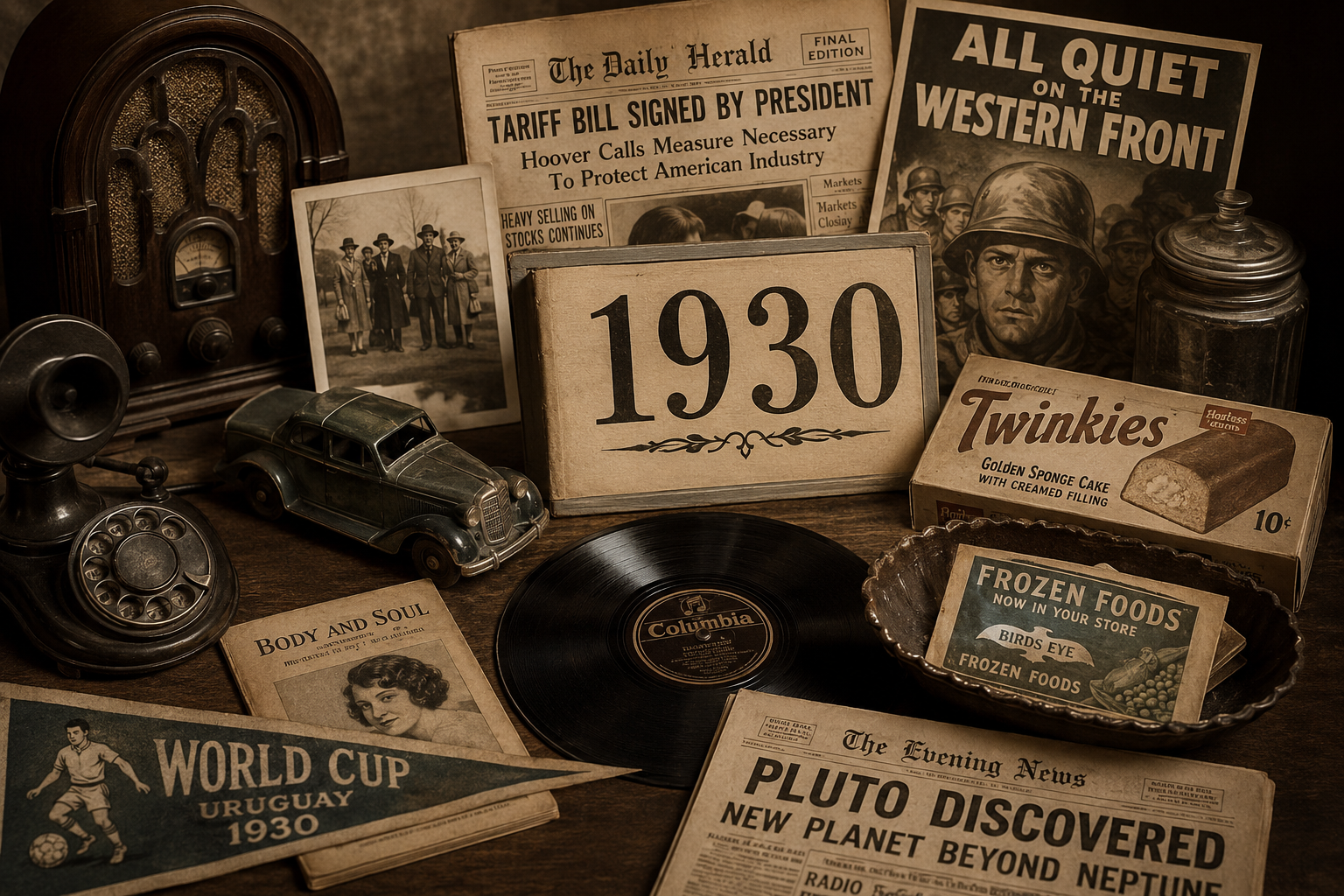
1930 opened the decade with radio nights, early sound movies, Depression-era uncertainty, newspaper headlines, kitchen-table budgeting, and new inventions that hinted at the future. It was the year Pluto was discovered on February 18, Birds Eye-style frozen foods reached retail stores on March 6, the Smoot-Hawley Tariff was signed on June 17, the first FIFA World Cup began on July 13, and Bobby Jones completed golf’s Grand Slam on September 27.
On This Page
Quick Look
1930 At A Glance
Before we open the full scrapbook, here are the dated milestones, pop culture moments, and everyday memories that help define 1930.
The Sound Of 1930
Music In 1930
The sound of 1930 belonged to radio, records, dance bands, crooners, theater songs, and music that traveled from stage to screen to living room. The country was entering the hard years of the Great Depression, but music still gave people a way to gather, dance, hum along, and feel a little lighter for a few minutes.
Songs connected to 1930 memory include “Body And Soul,” “Georgia On My Mind,” “I Got Rhythm,” “Three Little Words,” and “Happy Days Are Here Again.” Some were heard through records, some through stage and film, and many through radio performances that made a song feel familiar even before everyone owned a copy.
Music in 1930 could feel elegant, sentimental, jazzy, funny, or hopeful. It lived in ballrooms, movie theaters, hotel lounges, vaudeville houses, family parlors, and radios that people gathered around after dinner.
1930 Music Memory
A 1930 song might come from a record, a movie musical, a dance band, or the family radio, but once people knew the melody, it could follow them everywhere.
Screens And Speakers
Movies And Radio In 1930
By 1930, talking pictures were no longer a novelty. Movie theaters were changing fast, and audiences were hearing voices, songs, jokes, and dramatic speeches on screen in a way that had only recently become normal. The silent-film world was fading, and Hollywood was learning how to tell stories with sound.
All Quiet On The Western Front became one of the year’s most important movie memories. It brought World War I to the screen with a seriousness that made it stand apart from lighter entertainment. Other 1930 movie memories include The Big House, Animal Crackers, Morocco, The Blue Angel, Hell’s Angels, and early animated shorts that helped shape cartoon history.
Radio was even more central to everyday life. Families gathered around the set for comedy, variety shows, music, news, drama, and serial storytelling. A radio could make the outside world feel close, whether it was bringing in a song, a sponsor jingle, a sports update, a political speech, or a voice from a city far away.
1930 Screen Memory
Movies were learning to talk, and radios were already talking to everybody.
Childhood Memories
Toys, Kids, And Home Life In 1930
Childhood in 1930 looked very different depending on where a family lived and how the Depression was already affecting the household. Some children had dolls, toy trains, marbles, tin toys, balls, books, paper dolls, blocks, and board games. Others made more of their play from what was around them: sticks, stones, scrap wood, homemade toys, hand-me-downs, sidewalk games, and imagination.
Radio helped shape kid life too. Children listened along with parents, heard music and stories, and learned voices from the radio the way later generations learned television characters. Cartoons and comic strips also mattered. Betty Boop’s first appearance in 1930 pointed toward a more playful, jazzy animation style that would become part of the decade’s pop culture.
At home, families stretched what they had. Clothes were mended, meals were planned carefully, and entertainment often happened inside the home. A simple board game, a borrowed book, a neighborhood baseball game, or a radio program could mean a lot when money was tight.
1930 Kid Memory
A 1930 childhood could mean marbles in a pocket, a comic strip in the newspaper, a homemade toy, and everyone listening to the same radio at night.
Around The Table
Food, Home, And Everyday Life In 1930
Food memories from 1930 are tied closely to thrift, practicality, and making things stretch. Families leaned on soups, beans, bread, potatoes, canned goods, leftovers, garden vegetables, simple cakes, coffee, sandwiches, and whatever could feed people without wasting money.
But 1930 also brought food changes that pointed toward the future. Frozen foods reached retail stores on March 6 in Springfield, Massachusetts, showing how quick-freezing could eventually change shopping and cooking. Twinkies were also introduced in 1930, giving the year a snack-cake memory that would last for generations.
Everyday home life was practical. People listened to the radio, read newspapers, fixed what they could, reused what they had, and watched the economy with worry. A 1930 kitchen was not just a place for recipes. It was where family budgets, food plans, and survival strategies came together.
1930 Food Memory
A 1930 table could feel plain, careful, filling, and resourceful, with one eye on the pantry and the other on the family budget.
Headlines And Games
News, Culture, And Sports In 1930
The biggest feeling of 1930 was uncertainty. The stock market crash had happened the year before, and the Great Depression was settling into American life. Families watched jobs, wages, banks, farms, stores, and household budgets with growing concern.
On February 18, Clyde Tombaugh discovered Pluto at Lowell Observatory, giving newspapers and classrooms a space story that captured the imagination. On June 17, President Herbert Hoover signed the Smoot-Hawley Tariff Act, a major economic law that became part of the wider Depression story.
Sports offered escape and drama. The first FIFA World Cup ran from July 13–30 in Uruguay. On September 27, Bobby Jones completed golf’s Grand Slam. On October 8, the Philadelphia Athletics beat the St. Louis Cardinals to win the World Series.
1930 Headline Memory
1930 had worry at the kitchen table, wonder in the sky, and sports moments that gave people something to cheer about.
Memory Joggers
Questions That Bring 1930 Back
Use these prompts to remember the year yourself, ask an older relative, or start a family-history conversation about the early 1930s.
What Did The Radio Sound Like?
Think music, comedy, news, sponsored programs, distant stations, and the way a family might gather around one set.
What Did Families Do For Fun?
Think card games, board games, marbles, newspapers, movie matinees, neighborhood games, homemade toys, and music at home.
What Food Feels Like 1930?
Think soups, bread, beans, potatoes, leftovers, canned goods, garden vegetables, simple cakes, coffee, and careful shopping.
What Headline Would People Remember?
Think Pluto, the Depression, tariffs, sports victories, the first World Cup, and newspaper stories that came into the kitchen every morning.
1930 FAQ
Questions About 1930 Nostalgia
What Was 1930 Best Known For?
1930 is remembered for the early years of the Great Depression, Pluto being discovered on February 18, the Smoot-Hawley Tariff Act being signed on June 17, the first FIFA World Cup taking place from July 13–30, frozen foods reaching retail stores, and Bobby Jones completing golf’s Grand Slam.
What Music Was Popular In 1930?
Popular 1930 music memories include songs such as “Body And Soul,” “Georgia On My Mind,” “I Got Rhythm,” “Three Little Words,” and “Happy Days Are Here Again,” along with dance-band music, radio performances, and songs from stage and screen.
What Movies Were Popular In 1930?
Major 1930 movie memories include All Quiet On The Western Front, The Big House, Animal Crackers, Morocco, The Blue Angel, Hell’s Angels, and early sound-era cartoons.
What Was Everyday Life Like In 1930?
Everyday life in 1930 was shaped by the early Great Depression, radio entertainment, newspapers, practical meals, careful spending, homemade fun, mended clothes, simple toys, and families trying to stretch what they had.
Source Note
Remember That Year uses a mix of historical references, pop culture records, official archives, and nostalgic storytelling. For more historical context, visit History.com on Pluto’s discovery, the U.S. Senate history page on Smoot-Hawley, EBSCO on Clarence Birdseye and frozen foods, Hostess history, FIFA’s World Cup champions history, Bobby Jones history, USGA on Bobby Jones’ Grand Slam, and Baseball Reference on the 1930 World Series.